The Hidden Costs of Selling on Amazon Germany: What Foreign Sellers Must Know Before Entering the Market
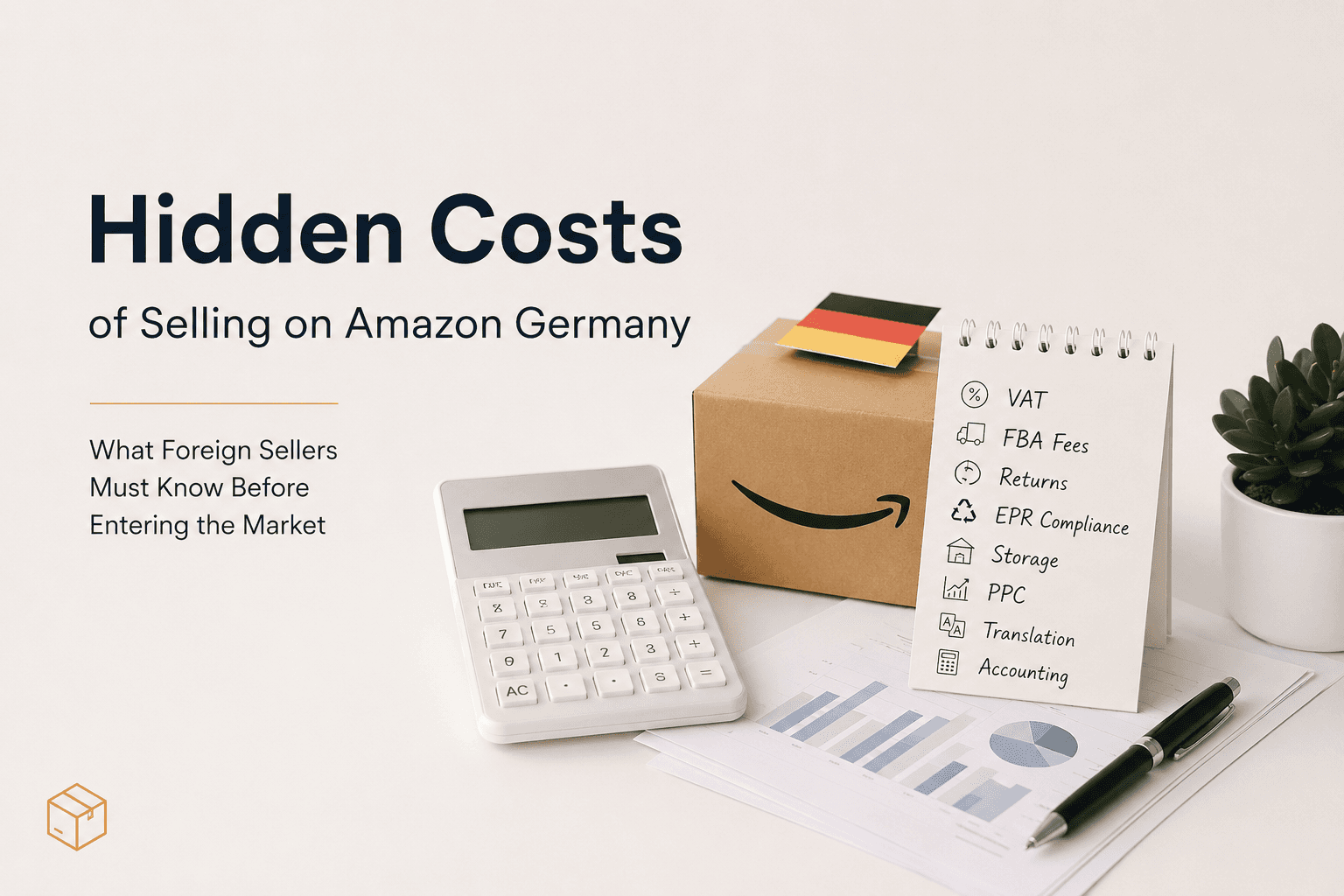
The Hidden Costs of Selling on Amazon Germany: What Foreign Sellers Must Know Before Entering the Market
Amazon Germany attracts thousands of international sellers because of its large customer base, strong purchasing power and developed FBA infrastructure.
For many businesses, Germany becomes the first serious step into the European Amazon market.
But many sellers enter the market with incomplete calculations.
They estimate:
• product cost
• Amazon referral fees
• FBA fees
• advertising budget
…and assume the remaining margin is profit.
Only later do they discover additional operational and regulatory costs:
• German VAT
• packaging law obligations
• LUCID registration
• dual system licensing
• returns
• localisation
• storage fees
• compliance documentation
• accounting
• Amazon EPR checks
This article explains the hidden costs of selling on Amazon Germany — not to discourage sellers, but to help sellers build realistic financial expectations before scaling.
Amazon Fees Are Only the Beginning
Most sellers start with Amazon’s visible fees.
Cost Type | Typical Impact |
|---|---|
Professional selling plan | Fixed monthly fee |
Referral fees | Percentage of each sale |
FBA fulfilment fees | Depends on size and weight |
Storage fees | Monthly warehouse charges |
PPC advertising | Variable but often substantial |
Promotions & coupons | Reduces real margin |
At first glance, the numbers may seem manageable.
Example
Item | Amount |
|---|---|
Selling price | €29.99 |
Product cost | -€8.00 |
Amazon fees | -€9.00 |
“Expected profit” | €12.99 |
But this calculation is incomplete.
It ignores VAT, returns, localisation, compliance costs, packaging obligations and operational overhead.
For many new sellers, this is where profitability calculations begin to collapse.
Amazon seller fees:
https://sell.amazon.de/en/preisgestaltung
VAT Changes the Entire Margin Structure
One of the biggest mistakes new sellers make is calculating profit using the gross Amazon selling price.
Germany’s standard VAT rate is 19%.
Example
Item | Amount |
|---|---|
Amazon.de selling price | €29.99 |
Included German VAT | -€4.79 |
Actual net revenue | €25.20 |
This means the seller is not working with €29.99 revenue.
The usable business revenue is much lower.
For a Business Generating €10,000/Month on Amazon Germany
Metric | Approximate Amount |
|---|---|
Gross revenue | €10,000 |
VAT portion (19%) | ~€1,596 |
Revenue before VAT | ~€8,404 |
Many sellers underestimate how strongly VAT affects:
• pricing
• cash flow
• profitability
• accounting
• reinvestment capacity
This is especially important for businesses using tight-margin products.
Official German VAT OSS information:
https://www.bzst.de/DE/Unternehmen/Umsatzsteuer/One-Stop-Shop_EU/one_stop_shop_eu_node.html
FBA Storage Can Quietly Become Expensive
FBA simplifies logistics, but storage costs become dangerous when inventory planning is weak.
A seller generating around €10,000/month revenue may easily have:
• €4,000–€12,000 worth of stock sitting inside Amazon warehouses
• inventory moving slower than expected
• cash flow locked in unsold inventory
Example Scenario
Expected Sales | Reality |
|---|---|
300 units/month expected | 80 units/month actual |
Result:
• stock remains in warehouses for many months
• storage fees continue accumulating
• aged inventory fees may appear
• additional discounts and PPC become necessary
For oversized or slow-moving products, storage-related charges may eventually become larger than the product’s expected profit margin.
This becomes especially painful during Q4, when Amazon storage fees increase.
Amazon FBA storage information:
https://sellercentral.amazon.de/help/hub/reference/external/GJ9NNG7RK4TU6E3Z
Packaging Law and LUCID Registration
This is one of the most misunderstood cost areas for foreign Amazon sellers.
If a business places packaged goods onto the German market, it may be legally required to:
• register in LUCID
• participate in a dual system
• report packaging volumes
Many sellers incorrectly assume:
“Amazon handles fulfilment, so Amazon handles packaging compliance.”
That assumption is often wrong.
Even with FBA, the seller may still be considered responsible under the German Packaging Act.
Typical Packaging Compliance Costs
Requirement | Approximate Cost |
|---|---|
LUCID registration | Usually free |
Dual system licence (small seller) | €50–€200/year |
Medium-sized seller | €300–€1,500/year |
Large-volume seller | Several thousand euros/year |
The actual licensing fee itself is often not the biggest problem.
The real operational costs are:
• understanding obligations
• tracking packaging materials
• maintaining accurate reporting
• synchronising data with Amazon
• correcting mistakes
• handling updates
A seller losing one successful listing for several weeks may lose far more money than the packaging licence itself costs.
Official LUCID register:
https://www.verpackungsregister.org/en/registration/find-out-about-registrations
Amazon EPR information:
https://sell.amazon.de/en/einhaltung-der-erweiterten-herstellerverantwortung
EPR Is Not Only About Packaging
Many sellers think EPR means only packaging registration.
In reality, obligations may extend much further depending on the product type.
Product Type | Possible Obligations |
|---|---|
Standard packaged goods | Packaging |
Electronics | Packaging + WEEE |
Products with batteries | Packaging + Battery Law |
Electrical beauty devices | Packaging + WEEE + batteries |
Certain plastic products | Packaging + single-use plastic rules |
This is where many foreign sellers become confused.
A business may complete packaging registration correctly while still remaining non-compliant in another EPR category.
That creates serious risk because Amazon increasingly checks EPR compliance information.
Amazon Seller Central EPR overview:
https://sellercentral.amazon.de/help/hub/reference/external/G6SQMSCSKWJQEPJQ
Returns Can Destroy Margins Faster Than Sellers Expect
Germany has strong consumer protection culture and relatively high customer expectations.
Returns are not only an inconvenience — they are a direct financial cost.
Typical Return-Related Costs
Cost Type | Financial Impact |
|---|---|
Refunds | Lost revenue |
Return shipping | Additional logistics expense |
Unsellable inventory | Full or partial inventory loss |
Inspection/repackaging | Operational labour |
Lost PPC spend | Advertising already consumed |
Negative reviews | Reduced future conversion |
Example
Metric | Amount |
|---|---|
Monthly revenue | €10,000 |
Return rate | 12% |
Returned order value | €1,200/month |
If even half of returned products become unsellable or heavily discounted, monthly losses can become substantial.
In categories such as:
• fashion
• shoes
• beauty devices
• electronics
…return rates may become dramatically higher.
This is why localisation, accurate sizing, clear instructions and realistic product expectations matter so much in Germany.
Poor Translation Costs More Than Good Translation
Many sellers try to minimise launch costs by using automatic translation tools only.
But weak localisation often creates much larger losses later through:
• poor conversion rates
• customer confusion
• higher returns
• wasted PPC spending
• lower trust
Approximate Localisation Costs
Service | Approximate Cost |
|---|---|
Basic listing translation | €30–€150 |
Professionally localised listing | €150–€500 |
Premium SEO localisation + A+ content | €500–€2,000+ |
A poorly translated listing may reduce conversion rates enough to cost far more than professional localisation would have cost initially.
German customers generally expect:
• clear wording
• accurate specifications
• professional instructions
• natural language
Translation on Amazon Germany is not only about language.
It directly affects:
• SEO
• trust
• conversion
• returns
• compliance risk
PPC Advertising Becomes a Major Operational Cost
Many sellers underestimate how expensive Amazon PPC can become in Germany.
In competitive categories, advertising often becomes one of the largest operational expenses.
Typical PPC Spending Examples
Monthly Revenue | Possible PPC Spend |
|---|---|
€5,000 revenue | €500–€1,500 |
€10,000 revenue | €2,000–€4,000 |
€50,000 revenue | €10,000+ possible |
For new products without reviews, ACoS may temporarily exceed 30–50%.
That means sellers may spend:
• €30–€50 in advertising
• for every €100 in attributed sales
This becomes dangerous when:
• the listing converts poorly
• the product lacks differentiation
• pricing is weak
• translation is poor
PPC cannot permanently compensate for a weak listing.
Compliance Documentation Is Often Ignored Until It Becomes a Problem
Many products sold in Germany require more than just a listing.
Depending on category, sellers may need:
Product Type | Possible Requirements |
|---|---|
Electronics | CE documentation, WEEE |
Toys | Safety testing |
Cosmetics | Responsible person, EU cosmetic compliance |
Food supplements | Ingredient and claim restrictions |
Food products | Allergen and labelling requirements |
Textiles | Fibre composition labelling |
Compliance costs vary heavily.
Product Category | Possible Additional Costs |
|---|---|
Simple household product | Minimal |
Electronics | Hundreds or thousands of euros |
Cosmetics | Ongoing compliance costs |
Toys | Testing and certification costs |
Many sellers discover these obligations only after inventory has already been manufactured or shipped.
That can become extremely expensive.
Accounting and Administration Become Real Business Costs
Even relatively small Amazon Germany operations generate administrative workload.
Typical Recurring Tasks
Task | Frequency |
|---|---|
VAT reporting | Monthly or quarterly |
Packaging reporting | Periodic |
Amazon EPR checks | Ongoing |
Inventory analysis | Weekly |
PPC optimisation | Weekly |
Returns analysis | Monthly |
Listing maintenance | Ongoing |
Approximate Support Costs
Service | Approximate Monthly Cost |
|---|---|
VAT/accounting support | €100–€500+ |
EPR/compliance support | €50–€300+ |
Bookkeeping | €100–€1,000+ depending on size |
For larger multi-country Amazon businesses, administration itself can become a full-time operational role.
Even when sellers do everything themselves, it still has a cost:
time.
A More Realistic Margin Calculation
At first glance, a product with a €10–€15 margin may appear highly profitable.
But after real operational costs are included, the picture changes significantly.
Simplified Calculation
Item | Amount |
|---|---|
Selling price | €29.99 |
Product cost | -€7.00 |
Amazon fees | -€8.00 |
“Expected profit” | €14.99 |
More Realistic Calculation
Item | Amount |
|---|---|
Gross selling price | €29.99 |
VAT | -€4.79 |
Product cost | -€7.00 |
Freight/import allocation | -€1.50 |
Amazon fees | -€8.00 |
PPC cost | -€4.00 |
Packaging/EPR allocation | -€0.20 |
Returns allowance | -€1.50 |
Admin/accounting allocation | -€0.50 |
Estimated real profit | ~€2.20 |
A seller generating €10,000/month revenue with a true 5% margin may ultimately earn only around €500 actual operational profit before broader taxes and business expenses.
That surprises many new sellers entering Germany.
Final Thought
Germany is not a “bad” Amazon market.
In many cases, it is one of the strongest opportunities in Europe.
But successful sellers usually approach Germany as a serious operational business — not as a simple marketplace launch.
The real question is not:
“Can I sell on Amazon Germany?”
The better question is:
“Can I remain profitable after VAT, Amazon fees, PPC, returns, storage fees, packaging obligations, EPR compliance and operational overhead?”
Prepared sellers calculate these costs before scaling.
Unprepared sellers discover them later — usually when margins already begin disappearing.
About the Author
This article was prepared by Packaging Compliance — a Germany-based project helping online sellers understand German packaging law, LUCID registration and EPR-related obligations for Amazon and e-commerce businesses.
Home page:
https://packaging-compliance.de