What Foreign Amazon Sellers Should Know Before Selling in Germany
What Foreign Amazon Sellers Should Know Before Selling in Germany
Germany is one of the biggest Amazon markets in Europe.
Many international sellers want to expand there because of the large customer base and strong purchasing power.
But Germany is also known for strict regulations, compliance requirements and marketplace rules that can surprise new sellers.
The good news is that thousands of international sellers successfully operate in Germany today.
The key is understanding the system early and avoiding expensive beginner mistakes.
Germany Is Amazon’s Largest Market in Europe
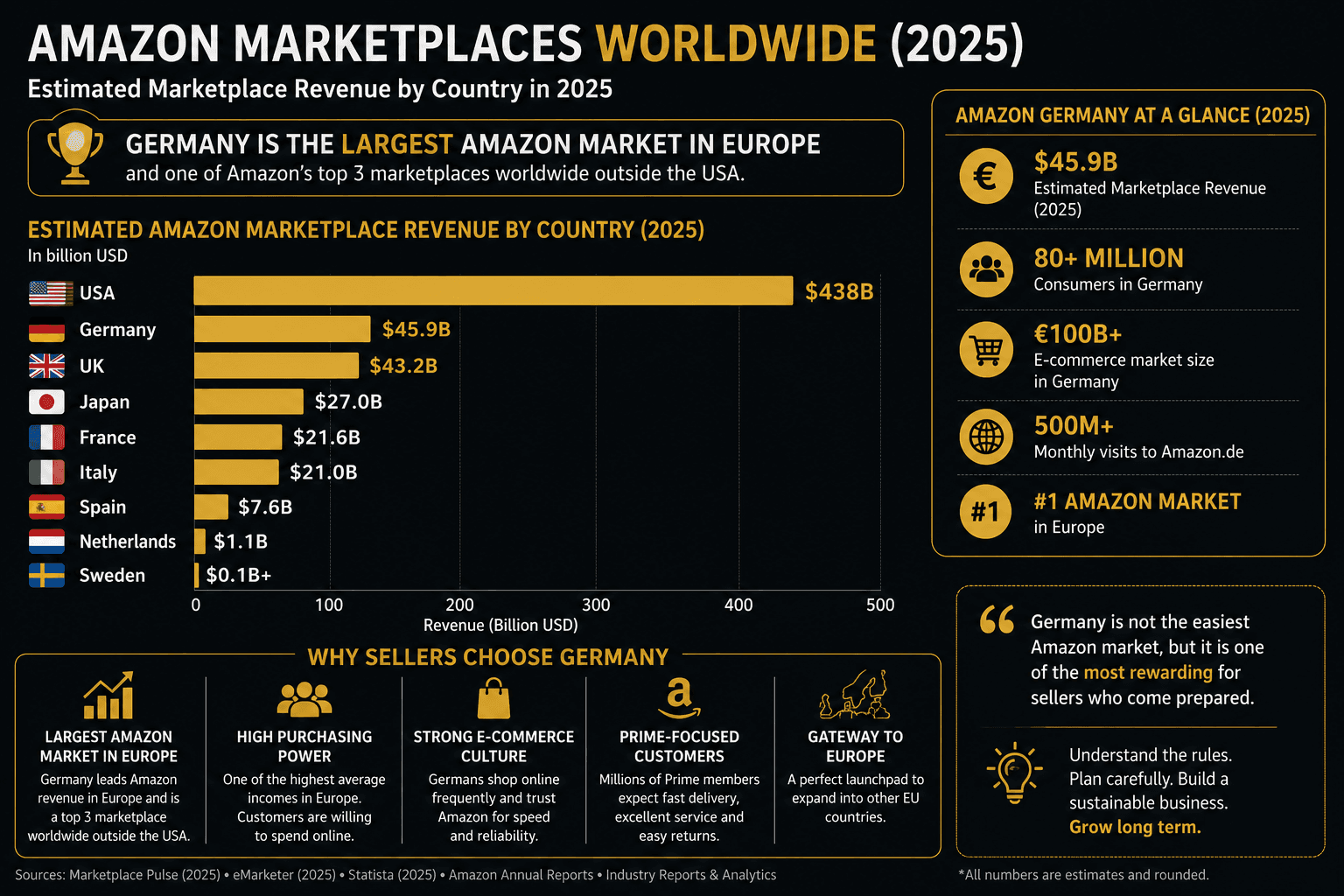
Germany remains Amazon’s biggest marketplace in Europe and one of Amazon’s largest markets worldwide outside the United States.
Estimated Amazon marketplace revenue in 2025:
USA — ~$438B
Germany — ~$45.9B
UK — ~$43.2B
Japan — ~$27B
France — ~$21.6B
Italy — ~$21B
Germany also has:
80+ million consumers,
one of Europe’s strongest ecommerce economies,
and over 500 million monthly visits to Amazon.de.
For many sellers, Germany becomes the gateway into the wider European market.
1. Germany takes compliance seriously
Many sellers believe Amazon handles everything automatically.
This is not always true.
Even if you sell through Amazon FBA, you may still be responsible for:
packaging compliance,
VAT obligations,
product regulations,
EPR registrations.
Amazon can request compliance information and sometimes deactivate listings if required data is missing.
Official German Packaging Register (LUCID):
LUCID Packaging Register
Official information from the German Central Packaging Register:
ZSVR Official Website
2. Packaging registration (LUCID) is often required
If you place packaged goods on the German market, you usually need:
a LUCID registration number,
participation in a packaging licensing system.
This applies to many Amazon sellers, including foreign businesses.
A common mistake is assuming:
“I only sell online, so this does not apply to me.”
In many cases, it still does.
3. High revenue does not always mean high profit
Germany is competitive.
Many new sellers focus only on:
revenue,
product trends,
sales velocity.
But real profitability also depends on:
PPC costs,
returns,
VAT,
storage fees,
compliance,
cash flow.
Some businesses grow fast but still struggle financially because costs become too high.
The good news is that sellers who monitor profitability carefully and control expenses often build much more stable businesses long term.
4. German Amazon customers return products frequently
This is something many new sellers underestimate.
In Germany, customers are very used to returning products — sometimes even for small reasons:
the packaging feels disappointing,
the product presentation looks different from the photos,
expectations were slightly different,
or simply because they changed their mind.
For some product categories, return rates can become very high.
This creates additional costs:
return processing,
damaged inventory,
refunds,
lost advertising costs,
warehouse fees.
Some businesses underestimate this and focus only on sales volume, while returns slowly destroy profitability.
That is why:
accurate product photos,
realistic descriptions,
strong packaging,
and clear customer expectations
are extremely important in the German market.
The positive side is that German customers also value:
consistency,
quality,
honest descriptions,
and professional sellers.
Businesses that build trust often create loyal long-term customers.
5. Logistics and inventory planning are important
Germany can be an excellent FBA market, but inventory issues can become expensive.
Sellers should monitor:
storage limits,
restock timing,
warehouse planning,
stranded inventory,
long-term storage fees.
Poor stock planning can damage both rankings and cash flow.
Many experienced sellers recommend starting smaller, learning the system first and scaling gradually instead of rushing large inventory orders too early.
6. Rules can change
Germany and the EU continue introducing new marketplace and environmental regulations.
For example:
EPR requirements,
packaging rules,
battery regulations,
single-use plastic obligations.
Sellers should stay informed and not assume older information is still correct.
Official Amazon EPR information:
Amazon EPR Requirements
Final thoughts
Germany can be a very strong opportunity for Amazon sellers.
But success usually requires more than simply uploading a product and running ads.
Understanding compliance, logistics and marketplace realities early can prevent expensive mistakes later.
For many sellers, preparation is the difference between long-term growth and constant problems.
The sellers who usually succeed long term are not always the ones with the biggest budgets — but the ones who:
stay informed,
adapt quickly,
and build sustainable systems.
Germany is not the easiest Amazon market — but for prepared sellers, it can become one of the most rewarding.
If you want to learn more about German packaging compliance and Amazon Germany requirements: