EPR Numbers in EU Countries: What Amazon Sellers Should Know
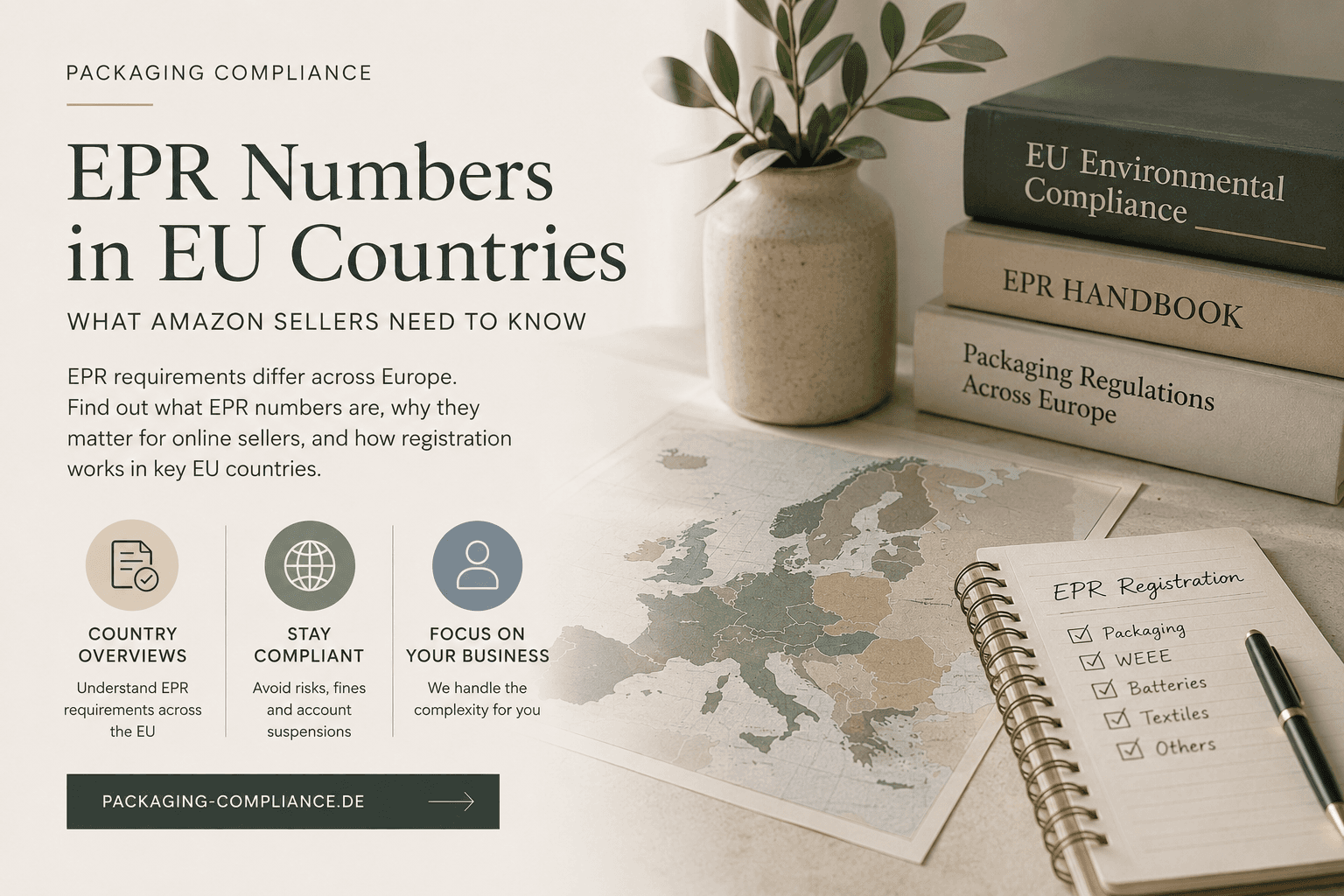
EPR Numbers in EU Countries: What Amazon Sellers Should Know
Extended Producer Responsibility (EPR) has become one of the most important compliance topics for online sellers operating in Europe. Many Amazon, eBay and Shopify sellers are surprised to discover that environmental registration requirements differ significantly across EU countries.
In Germany, sellers often know the system under the name “LUCID registration.” However, Germany is only one part of a much larger European EPR landscape.
What Is an EPR Number?
An EPR number is a registration number issued to companies that place certain products or packaging on the market in an EU country.
Depending on the country, EPR obligations may apply to:
packaging,
electronics,
batteries,
textiles,
furniture,
toys,
and other regulated product categories.
The purpose of EPR systems is to ensure that producers, importers and distributors contribute financially to waste collection, recycling and environmental management.
For online sellers, EPR numbers have become especially important because marketplaces such as Amazon increasingly require sellers to provide valid registration numbers.
Without valid EPR registration, sellers may face:
listing removals,
account restrictions,
shipment blocks,
or compliance warnings.
Germany: The LUCID Number
In Germany, the packaging EPR number is commonly known as the LUCID number.
Official sources:
Under the German Packaging Act (VerpackG), companies placing packaging on the German market must usually:
register in the LUCID system,
license packaging through a dual system,
and report packaging quantities correctly.
Registration in LUCID itself is free and usually completed online.
However, many sellers discover that the real complexity begins later — especially when trying to understand:
packaging classifications,
reporting obligations,
marketplace responsibilities,
and whether additional environmental systems may apply.
Why International Sellers Often Struggle
Many local German businesses manage EPR compliance independently, especially when they already have accounting departments or administrative staff familiar with German regulations.
Smaller sellers also often choose to do everything themselves in the beginning.
However, for international sellers, the situation can feel very different.
We once spoke with a U.S.-based entrepreneur preparing to expand into Amazon Germany. He described German EPR compliance as a “major obstacle” similar to obtaining a complicated certification — although he still planned to enter the market.
For sellers from different legal and business environments, understanding German administrative systems can sometimes feel overwhelming.
Additional Systems Can Create Confusion
One of the biggest challenges is understanding whether products may also fall under additional systems such as:
WEEE / electronics registration,
battery regulations,
or Germany’s single-use plastics fund system (EWKFonds / DIVID).
Official sources:
In practice, classification is not always straightforward.
For example:
individually wrapped sweets may be treated differently from unpackaged chocolate products,
portion ice cream may fall under different rules than frozen cakes,
and some plastic food packaging may or may not trigger additional obligations depending on how the product is intended to be consumed.
Even experienced sellers sometimes struggle to interpret these distinctions correctly.
EPR Systems Across EU Countries
Although EPR is based on EU directives, every EU country implements the system differently.
This means:
different registration authorities,
different reporting systems,
different thresholds,
and sometimes different product categories.
France
France has one of the strictest EPR systems in Europe. Besides packaging, EPR may also apply to:
textiles,
furniture,
toys,
sporting goods,
and garden products.
Official source:
Austria
Foreign sellers may need an authorized representative for certain packaging obligations.
Official source:
Spain
Packaging registration is commonly handled through Ecoembes.
Official source:
Italy
Packaging compliance is handled through the CONAI system.
Official source:
Netherlands
Packaging obligations are handled through Afvalfonds Verpakkingen.
Official source:
Poland
Companies often need registration in the BDO waste database system.
Official source:
Sweden
Packaging and recycling obligations are coordinated through Naturvårdsverket and approved collection systems.
Official source:
EPR in Europe Is Becoming More Important
Across Europe, environmental compliance requirements continue to expand.
More marketplaces now request:
packaging numbers,
WEEE numbers,
battery registrations,
and additional reporting data.
At the same time, many sellers still underestimate how different these systems can be from country to country.
Final Thoughts
For some businesses, handling EPR independently is completely realistic.
For others — especially international sellers operating across multiple EU countries — professional guidance can help avoid confusion, save time and reduce compliance risks.
At Packaging Compliance, we help Amazon sellers better understand German packaging compliance requirements and support them through the registration and reporting process.
Nadezda Walz
Master’s Degree in Economics and Management Sciences