Does EWKFonds (DIVID) Apply to Food Sellers Using Plastic Packaging?
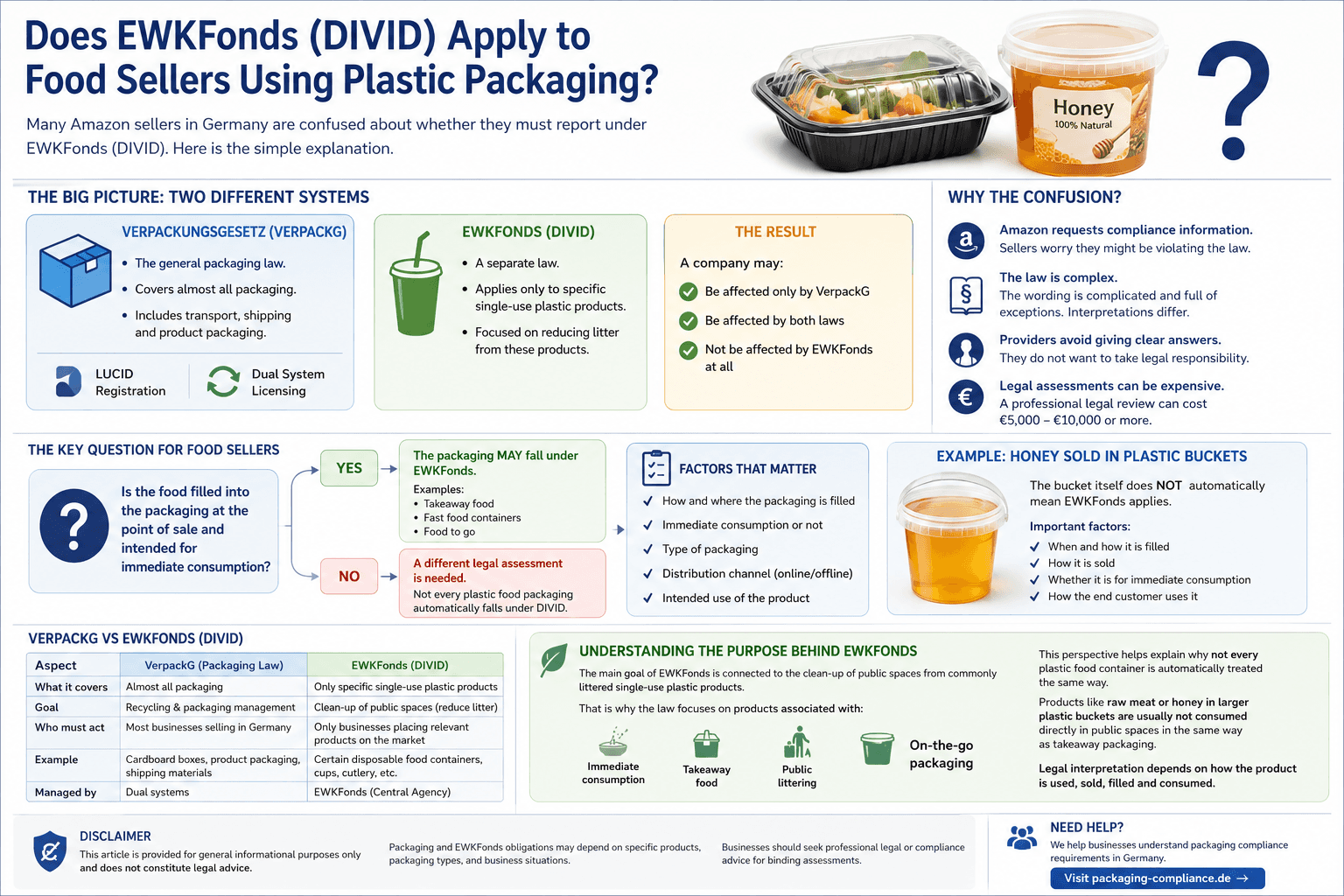
Does EWKFonds (DIVID) Apply to Food Sellers Using Plastic Packaging?
Many Amazon sellers in Germany are confused about whether they must report under EWKFonds (DIVID).
This confusion is especially common among food sellers using plastic packaging.
One of the biggest reasons is that Amazon increasingly requests compliance information, causing sellers to worry about possible violations even when the law itself is difficult to interpret.
Why Is This So Confusing?
The German Single-Use Plastics Fund (EWKFonds) applies only to certain disposable plastic products.
However, many sellers struggle to determine whether their packaging actually falls under the law.
This becomes especially complicated for:
honey sellers
food brands
importers
businesses using plastic buckets or containers
The Key Difference Many Sellers Miss
A very important distinction exists in German law.
In many situations, single-use food packaging is only affected if:
the food is filled into the packaging at the point of sale,
orprepared directly for immediate consumption.
This is where confusion begins.
Many packaged food products sold online may not automatically fall under the same category.
Example: Honey Sold in Plastic Buckets
This is a common example.
At first glance, a plastic honey bucket may appear to be single-use plastic packaging.
However, the legal classification may depend on:
how the product is filled,
when it is filled,
whether it is intended for immediate consumption,
how the product reaches the consumer.
This is why many sellers struggle to determine whether EWKFonds obligations apply to them.
Understanding the Purpose Behind EWKFonds
One thing that helped me better understand the logic behind the German Single-Use Plastics Fund was understanding its purpose.
The main goal of EWKFonds is connected to the clean-up of public spaces from commonly littered single-use plastic products.
This is why the law often focuses on products associated with:
immediate consumption,
takeaway food,
public littering,
and disposable on-the-go packaging.
This perspective helped explain why not every plastic food container is automatically treated the same way.
For example, products such as raw meat or honey sold in larger plastic buckets are usually not consumed directly in public spaces in the same way as takeaway food packaging.
This is one reason why sellers often struggle to determine whether certain products fall under EWKFonds obligations or not.
Because the legal interpretation may depend on how the product is used, sold, filled, and consumed.
Why Sellers Are Afraid
Many Amazon sellers fear:
compliance violations
Amazon restrictions
legal risks
fines
As a result, some companies consider expensive legal reviews simply to understand whether they are even affected by the law.
In some cases, professional legal assessments may cost thousands of euros.
For smaller businesses, paying large amounts just to learn that the law may not apply can feel unreasonable.
Why Nobody Wants to Give a Clear Answer
Another major issue is that many service providers avoid giving definitive answers.
The law can be complex and product-specific.
As a result, businesses are often left uncertain about:
whether they must register,
whether they must report,
or whether their packaging falls outside the scope of the regulation.
VerpackG vs EWKFonds (DIVID)
Many sellers also confuse:
Verpackungsgesetz (packaging law)
andEWKFonds (single-use plastics fund).
These are separate systems with different rules.
A company may have obligations under VerpackG but not necessarily under EWKFonds.
This is one of the biggest misunderstandings among Amazon sellers entering Germany.
Why Careful Analysis Matters
Understanding packaging obligations in Germany often requires careful analysis of:
product type,
packaging type,
filling process,
sales method,
and legal definitions.
This is especially true for food products.
Final Thoughts
EWKFonds compliance can be difficult to interpret, especially for food sellers using plastic packaging.
Many Amazon sellers assume that all plastic food packaging automatically falls under the law, but reality may be more nuanced.
Understanding the difference between packaging law and single-use plastics regulation is extremely important for businesses selling in Germany.
Disclaimer
This article is provided for general informational purposes only and does not constitute legal advice.
Packaging and EWKFonds obligations may depend on specific products, packaging types, and business situations.
Businesses should seek professional legal or compliance advice for binding assessments.
Need Help?
We help businesses better understand packaging compliance requirements in Germany, including:
VerpackG
LUCID
packaging licensing
EWKFonds guidance
Amazon-related compliance questions