Why Amazon Germany Sellers Get Blocked for EPR Compliance Issues
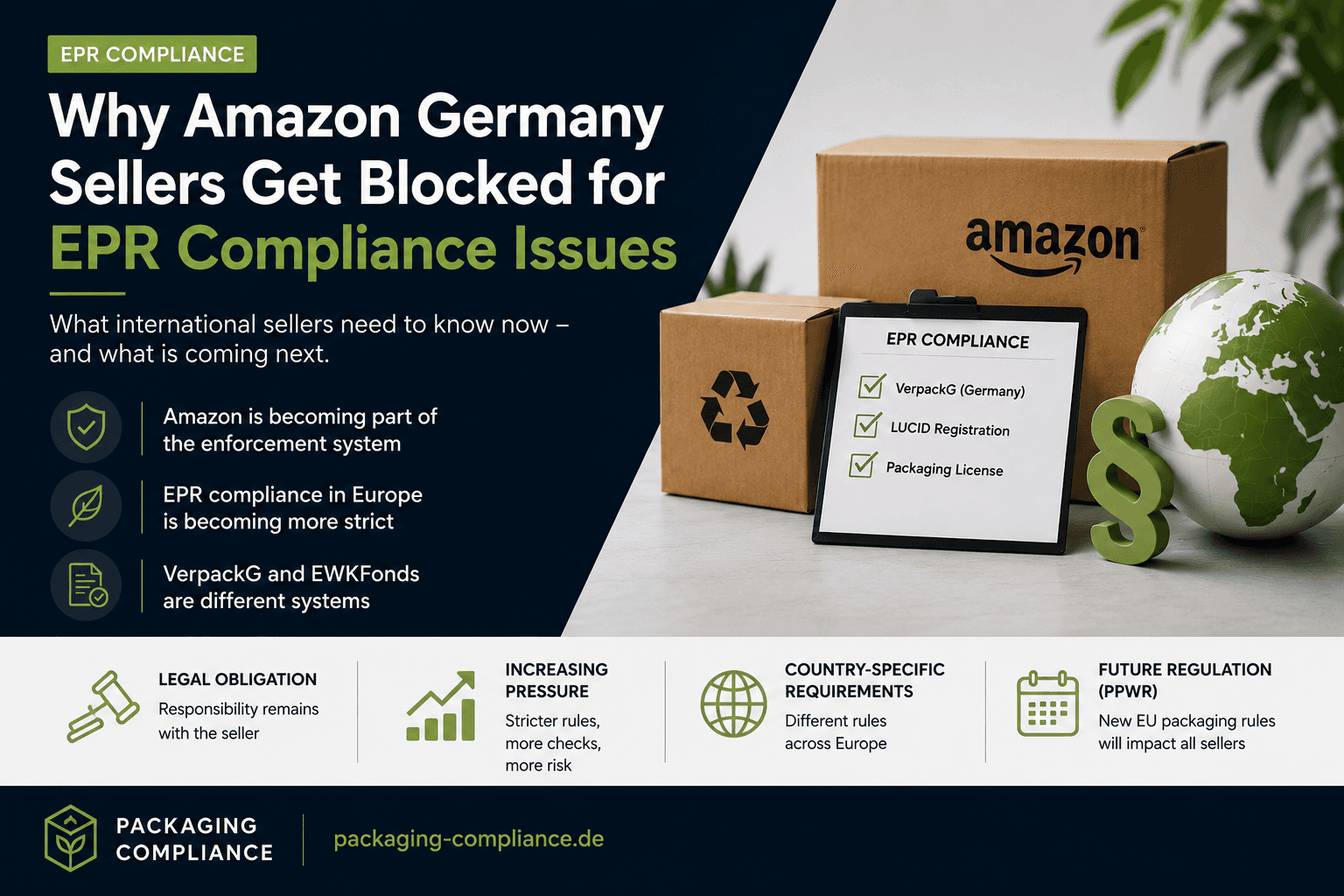
Article
Why Amazon Germany Sellers Get Blocked for EPR Compliance Issues
Many international Amazon sellers underestimate how seriously Germany treats EPR compliance.
One of the most common misunderstandings is believing that Amazon automatically handles all environmental compliance obligations for sellers.
In reality, sellers themselves remain responsible for complying with German environmental regulations.
In recent years, Amazon and other marketplaces have increasingly requested EPR-related information from sellers, including registration numbers and compliance documentation.
As a result, many international sellers only begin researching German compliance requirements after receiving warnings or listing restrictions.
What Is EPR in Germany?
Extended Producer Responsibility (EPR) is a legal framework that makes companies responsible for the environmental impact of certain products and packaging.
In Germany, this may include:
packaging (VerpackG)
electronics (WEEE / ElektroG)
batteries
certain single-use plastic products
Different obligations may apply depending on:
product category,
packaging type,
and how products are sold.
Why Foreign Sellers Are Often Confused
Germany has one of the strictest environmental compliance systems in Europe.
Many international sellers incorrectly assume:
Amazon handles everything,
FBA removes legal responsibility,
or one EU registration covers all European marketplaces.
Unfortunately, this is often not the case.
European compliance systems are fragmented, country-specific, and increasingly interconnected with marketplace enforcement.
Amazon Is Becoming Part of the Enforcement System
One of the most important changes many sellers do not fully understand is that marketplaces themselves are increasingly becoming part of environmental enforcement systems.
Amazon is not simply requesting compliance information voluntarily.
In many cases, marketplaces face their own legal obligations under European and national environmental laws.
This is one reason why sellers increasingly encounter:
automated compliance checks,
requests for registration numbers,
listing suspensions,
and account-related warnings.
The pressure is not coming only from Amazon itself.
It is also connected to broader European environmental policy trends focused on:
waste reduction,
recycling targets,
reducing single-use plastics,
and increasing producer responsibility.
Why Compliance Is Becoming More Complex
For many sellers, the challenge is no longer simply obtaining a registration number.
The real challenge is understanding how multiple environmental systems interact.
For example:
VerpackG,
EWKFonds,
WEEE,
battery regulations,
and future EU packaging regulations
may all apply differently depending on the business model and product category.
This is why many Amazon sellers struggle to determine:
which rules apply,
which registrations are required,
and which reporting obligations exist.
The Future: Why Packaging Rules in Europe Are Becoming More Strict
Many sellers are still unaware that Europe is moving toward even broader packaging regulation through the upcoming PPWR framework (Packaging and Packaging Waste Regulation).
The long-term direction of European environmental policy is becoming increasingly clear:
less unnecessary packaging,
more recyclable materials,
lower packaging waste,
stricter reporting requirements,
and greater producer responsibility.
These changes may affect:
Amazon sellers,
importers,
food brands,
private label businesses,
and international e-commerce companies.
For many businesses, compliance is becoming an ongoing operational responsibility rather than a one-time registration process.
Why Small Businesses Feel Overwhelmed
Large corporations often have:
legal departments,
compliance managers,
specialized consultants,
and internal environmental teams.
Small and medium-sized businesses usually do not.
As a result, many Amazon sellers attempt to understand highly technical environmental regulations while simultaneously managing:
inventory,
logistics,
advertising,
customer service,
and marketplace operations.
This is one reason why confusion surrounding EPR, VerpackG, and EWKFonds has become so common among smaller sellers.
Common Mistakes International Sellers Make
Assuming Amazon Handles Everything
Amazon may collect compliance information, but legal responsibility usually remains with the seller.
Registering Only in LUCID
LUCID registration alone is often not enough.
Many businesses may also require:
packaging licensing,
reporting obligations,
or additional registrations.
Ignoring Country-Specific Rules
Europe is not a single unified compliance system.
Germany, France, Spain, and other countries may all have separate environmental obligations.
Confusing VerpackG with EWKFonds
Many sellers incorrectly assume that all plastic packaging automatically falls under EWKFonds.
However, VerpackG and EWKFonds are separate systems with different legal scopes and different regulatory purposes.
This confusion is especially common among food sellers using plastic packaging.
For example, many businesses struggle to understand whether products such as honey buckets or food containers actually fall under single-use plastics obligations.
One important factor is understanding the purpose behind EWKFonds itself, which is largely connected to reducing littering from commonly discarded single-use plastic products in public spaces.
You can read a more detailed explanation here:
👉 https://www.packaging-compliance.de/blog/ewkfonds-divid-food-packaging-germany
Final Thoughts
Selling on Amazon Germany can be highly profitable, but environmental compliance risks are often underestimated.
For many international sellers, the biggest challenge is not unwillingness to comply.
The real challenge is understanding which regulations apply to specific products, packaging types, and business models.
As European environmental laws continue evolving, businesses that understand compliance early may avoid:
listing suspensions,
unnecessary panic,
fines,
and costly operational problems later.
Disclaimer
This article is provided for general informational purposes only and does not constitute legal advice.
EPR obligations may depend on specific products, packaging types, and business situations.
Businesses should seek professional legal or compliance advice for binding assessments.
Need Help?
We help international sellers better understand German packaging compliance requirements, including:
LUCID
VerpackG
packaging licensing
EWKFonds
Amazon-related compliance questions